
With the current uncertainty in the Middle East and broader market volatility, many business owners and CFOs are asking how this environment will influence discussions with their bank around financing.
Common questions we are hearing include:
Will the bank support the transaction?
How long will approval take?
How closely will the application be scrutinised?
Will they require additional security or tighter covenants?
Should we approach only our existing bank or test the market?
These are valid questions. Periods of economic uncertainty tend to change how banks assess risk and credit exposure. Even when lending appetite remains intact, credit teams will often apply more rigorous stress testing before approving transactions.
Bank Credit Insights
As a former credit analyst and risk manager, I know that bank credit teams will focus on several specific areas when evaluating business lending proposals.
To help prepare our clients for conversations with lenders, we prepared a short Lending Insight Brief: 5 Things Banks Are Stress-Testing in Business Lending Right Now.
The briefing outlines:
Key areas banks stress test in mid-market lending
How the current environment influences credit appetite
Questions credit teams ask behind the scenes
Financial metrics and sensitivities lenders analyse
What management teams should be prepared to address before approaching lenders
What Banks Are Stress Testing in Business Lending Right Now
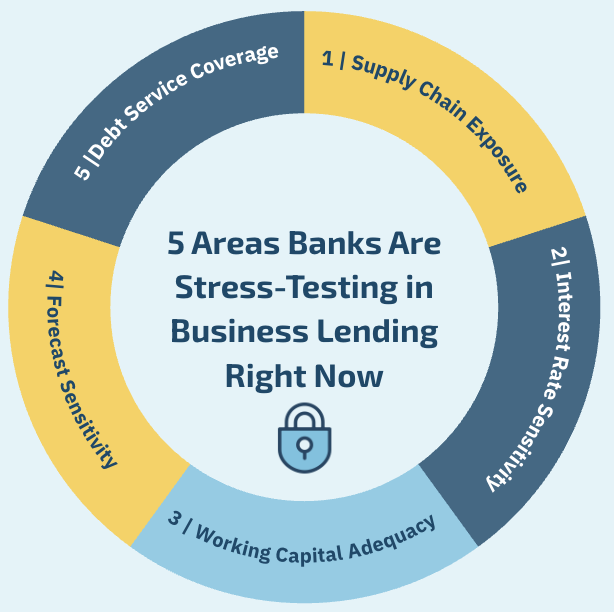
1. Supply Chain Exposure
Banks are paying closer attention to how global disruptions flow through supply chains.
Rising oil prices can increase freight and logistics costs, while currency volatility can materially change the cost of imported inputs. Credit teams increasingly test whether businesses have the pricing power, margin buffer, or contractual protections to absorb these shifts.
Key question banks are asking:
“How exposed is the business to external cost shocks it cannot control?”
2. Interest Rate Sensitivity
With expectations of further interest rate increases, banks continue to assess how resilient businesses are to higher borrowing costs.
Credit teams stress test interest rate sensitivity by adding additional interest rate buffers to lending rates and testing debt service capacity. Businesses with thinner margins or higher leverage may see interest cover and debt service ratios tighten quickly under these scenarios. The focus is not today's interest rate. It is how the business performs if funding costs move against it.
Key question banks are asking:
“What is the interest rate sensitivity for the business borrowing - how much increase in rates can the business absorb?”
3. Working Capital Adequacy
Many businesses underestimate how closely banks now examine working capital dynamics.
Growth, supply chain disruption, or slower customer payments can quickly create funding pressure. Credit teams increasingly assess whether working capital facilities are adequate for the scale and volatility of the business and whether the current economic headwinds will impact working capital.
Key question banks are asking:
“Does the business have enough liquidity to absorb operational shocks without creating repayment risk?”
4. Forecast Sensitivity
Forecasts are rarely accepted at face value. Banks typically stress-test revenue assumptions, margin expectations and cost forecasts to understand how quickly performance could deteriorate if conditions soften. Even modest changes to sales volumes, pricing or input costs can materially affect lending capacity.
Key question banks are asking:
“What sensitivities do we need to run on projections to stress test company submitted forecasts?”
5. Debt Service Coverage
Ultimately, most lending decisions come back to one central question: Can the business comfortably service its debt? Banks focus on debt service coverage under certain assumptions. This often involves adjusting EBITDA, testing cash flow volatility or modelling downside scenarios. The emphasis is less on headline profitability and more on sustainable cash flow available to meet debt obligations.
Key question banks are asking:
“How strong is debt service capacity under stress test scenarios and does it meet our minimums?”
Quick Diagnostic
If you are preparing for a funding discussion with your bank, consider how confidently you could answer the following:
How exposed is our business to supply chain or FX shocks?
How resilient are we if interest rates remain higher for longer?
Is our working capital facility sufficient for operational volatility?
How sensitive are our forecasts to changes in assumptions?
Would our debt service metrics pass a conservative bank credit assessment?
If any of these questions are difficult to answer with confidence, it may be worth reviewing how the funding request is structured before approaching lenders.